
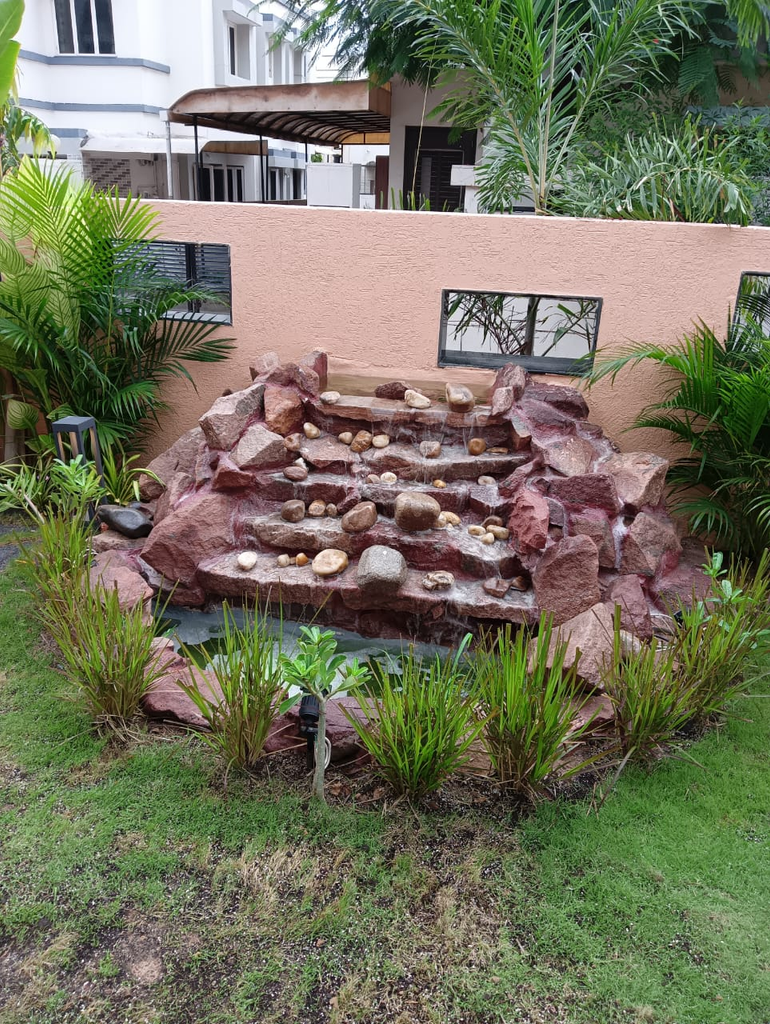
Designing koi fish ponds, stone water cascades, and custom fountains with integrated filters.
A water feature adds something planting and hardscape alone can’t — movement and sound — but it also introduces a set of ongoing mechanical and biological demands that a static garden element never has to deal with. Getting one right means designing for its long-term upkeep from the start, not just for how it looks the day it’s finished.
What Goes Into a Working Water Feature
Koi Fish Ponds
A pond built to actually support fish needs adequate depth and volume for temperature stability, a filtration system sized for the fish load, and oxygenation to keep the water healthy — a pond designed purely for looks, without these, tends to struggle to keep fish alive through seasonal temperature swings.
Stone Water Cascades
A cascade depends on getting the flow rate, drop height, and stone placement right so water moves and sounds the way it’s meant to — too little flow looks static, too much becomes noisy or splashes outside the intended catch basin, so this is usually tuned on site rather than fully finalized on paper.
Custom Fountains
Fountains are often built as a centerpiece feature, and their scale and style need to suit the space around them — a fountain sized for a large open courtyard reads very differently, and needs a different pump and basin size, than one meant for a small residential corner.
Integrated Filtration
Any water feature that isn’t regularly drained and refilled needs a filtration system to keep the water clear and prevent algae buildup — this is usually the part clients notice least when it’s working well and notice immediately when it isn’t, so it’s sized generously relative to the feature rather than as an afterthought.
Pump Sizing & Energy Use
The pump has to match the feature’s flow requirements and total water volume — undersized and the feature underperforms or the water doesn’t circulate enough to stay clean; oversized and it wastes energy and can be unnecessarily loud for a residential setting.
Why Ongoing Maintenance Is Part of the Design
A water feature isn’t a one-time installation the way a planting bed largely is — pumps need periodic servicing, filtration needs cleaning, and water quality needs monitoring, especially where fish are involved. Designing with maintenance access and appropriately sized equipment from the start is what keeps a water feature running well for years instead of becoming a recurring source of problems.