
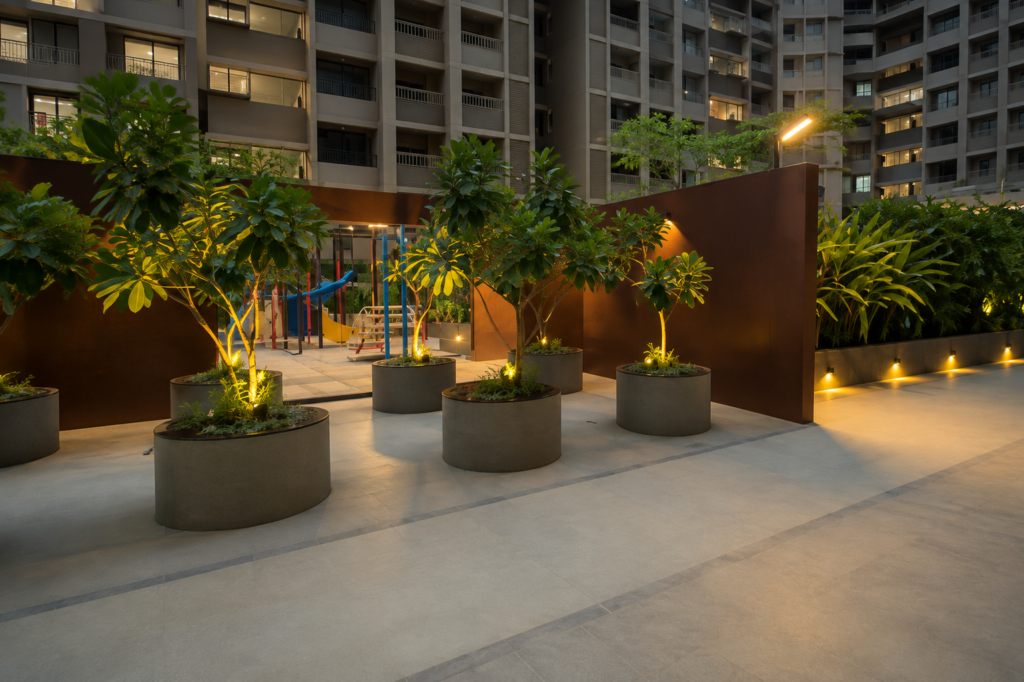
Green masterplanning for housing estates, hotels, tech parks, and corporate offices.
Residential and commercial landscaping share the same underlying craft — planting, grading, hardscape — but the priorities behind each are different enough that a plan built for one rarely transfers well to the other. A homeowner’s garden is designed around personal use and preference; a housing estate, hotel, or corporate office is designed around consistency, durability, and how large numbers of people move through and experience the space every day.
What Changes at This Scale
Master Planning for Estates
Housing estates and larger residential developments need a landscape plan that stays coherent across many individual plots and shared areas — common green spaces, entry statements, and streetscape planting all have to work as one connected design rather than as unrelated pieces next to each other.
Hospitality Grounds
Hotel landscaping has to hold up to a different kind of use than a private garden — constant foot traffic, high visual expectations from guests, and grounds that need to look consistently presentable year-round rather than accommodating an owner’s personal seasonal preferences.
Tech Parks & Corporate Campuses
Office and campus landscaping typically balances two goals at once — grounds attractive enough to reflect well on the business, and outdoor areas that actually get used by employees for breaks or informal meetings, rather than purely decorative space that sits empty.
Durability & Low-Maintenance Priorities
Commercial and estate-scale planting generally leans toward hardier, lower-maintenance species and materials, since the cost and logistics of maintaining a high number of high-input plants across a large shared space adds up quickly compared to a single residential garden.
Consistency Across a Site
Whether it’s a housing estate or a corporate campus, matching plant palettes, hardscape materials, and signage-adjacent greenery across the whole property is what gives it a cohesive, intentional feel — inconsistency between sections tends to read as unplanned even when each individual area looks fine on its own.
Why the Same Skillset Needs a Different Approach
The technical work — grading, planting, irrigation, hardscape — carries over between residential and commercial projects, but the priorities driving the design don’t. A commercial or estate-scale project succeeds by being coherent, durable, and low-maintenance at scale, where a residential garden succeeds by fitting one household’s specific way of living in the space.